
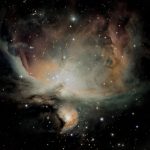
 A nebula is a giant cloud of dust and gas in space. Some nebulae (more than one nebula) come from the gas and dust thrown out by the explosion of a dying star, such as a supernova. Other nebulae are regions where new stars are beginning to form. For this reason, some nebulae are called “star nurseries.”
Most nebulae are of vast size; some are hundreds of light-years in diameter. A nebula that is barely visible to the human eye from Earth would appear larger, but no brighter, from close by. The Orion Nebula, the brightest nebula in the sky and occupying an area twice the diameter of the full Moon, can be viewed with the naked eye but was missed by early astronomers.
How do stars form in a nebula?
Nebulae are made of dust and gases—mostly hydrogen and helium. The dust and gases in a nebula are very spread out, but gravity can slowly begin to pull together clumps of dust and gas. As these clumps get bigger and bigger, their gravity gets stronger and stronger.
Eventually, the clump of dust and gas gets so big that it collapses from its own gravity. The collapse causes the material at the center of the cloud to heat up-and this hot core is the beginning of a star.