
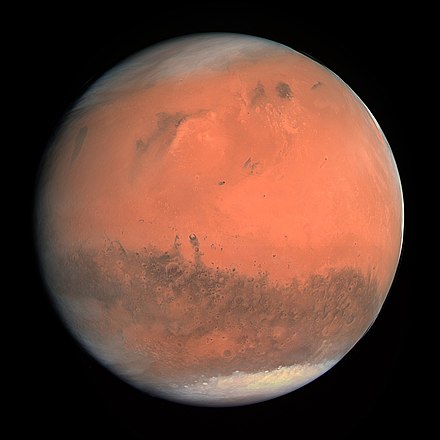
 Mars is the fourth planet from the Sun and the second-smallest planet in our Solar System after Mercury. In English, Mars carries a name of the Roman god of war, and is often referred to as the “Red Planet” because the reddish iron oxide prevalent on its surface gives it a reddish appearance that is distinctive among the astronomical bodies visible to the naked eye.
Mars is a terrestrial planet with a thin atmosphere also having surface features reminiscent both of the impact craters of the Moon and the valleys, deserts, and polar ice caps of Earth.
With a radius of 2,106 miles (3,390 kilometers), Mars is about half the size of Earth. If Earth were the size of a nickel, Mars would be about as big as a raspberry.
From an average distance of 142 million miles (228 million kilometers), Mars is 1.5 astronomical units away from the Sun. One astronomical unit (abbreviated as AU), is the distance from the Sun to Earth. From this distance, it takes sunlight 13 minutes to travel from the Sun to Mars.
As Mars orbits the Sun, it completes one rotation every 24.6 hours, which is very similar to one day on Earth (23.9 hours). Martian days are called sols—short for “solar day.” A year on Mars lasts 669.6 sols, which is the same as 687 Earth days.
Mars is about half the size of Earth, and like its fellow terrestrial planets, it has a central core, a rocky mantle and a solid crust.