
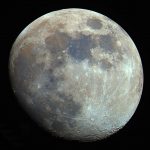
 Earth’s Moon is the only place beyond Earth where humans have set foot.
The brightest and largest object in our night sky, the Moon makes Earth a more livable planet by moderating our home planet’s wobble on its axis, leading to a relatively stable climate. It also causes tides, creating a rhythm that has guided humans for thousands of years. The Moon was likely formed after a Mars-sized body collided with Earth.
Earth’s only natural satellite is simply called “the Moon” because people didn’t know other moons existed until Galileo Galilei discovered four moons orbiting Jupiter in 1610.
With a radius of 1,079.6 miles (1,737.5 kilometers), the moon is less than a third the width of Earth. If Earth were the size of a nickel, the moon would be about as big as a coffee bean.
The moon is farther away from Earth than most people realize. The moon is an average of 238,855 miles (384,400 kilometers) away. That means 30 Earth-sized planets could fit in between Earth and the moon.
The moon is slowly moving away from Earth, getting about an inch farther away each year.
The moon is rotating at the same rate that it revolves around Earth (called synchronous rotation), so the same hemisphere faces Earth all the time.
With too sparse an atmosphere to impede impacts, a steady rain of asteroids, meteoroids and comets strikes the surface of the moon, leaving numerous craters behind. Tycho Crater is more than 52 miles (85 kilometers) wide.
Over billions of years, these impacts have ground up the surface of the moon into fragments ranging from huge boulders to powder. Nearly the entire moon is covered by a rubble pile of charcoal-gray, powdery dust and rocky debris called the lunar regolith. Beneath is a region of fractured bedrock referred to as the megaregolith.