
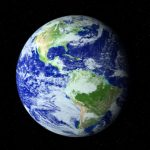
 Our home planet Earth is a rocky, terrestrial planet. It has a solid and active surface with mountains, valleys, canyons, plains and so much more. Earth is special because it is an ocean planet. Water covers 70% of Earth’s surface.
Our atmosphere is made mostly of nitrogen and has plenty of oxygen for us to breathe. The atmosphere also protects us from incoming meteoroids, most of which break up in our atmosphere before they can strike the surface as meteorites.
Since we live here, you might think we know all there is to know about Earth. Not at all, actually! We have a lot we can learn about our home planet. Right now, there are many satellites orbiting Earth taking pictures and measurements. This is how we can learn more about weather, oceans, soil, climate change, and many other important topics.
With a radius of 3,959 miles (6,371 kilometers), Earth is the biggest of the terrestrial planets, and the fifth largest planet overall.
From an average distance of 93 million miles (150 million kilometers), Earth is exactly one astronomical unit away from the Sun because one astronomical unit (abbreviated as AU), is the distance from the Sun to Earth. This unit provides an easy way to quickly compare planets’ distances from the Sun.
It takes eight minutes and 20 seconds for light from the Sun to reach our planet.
Earth’s axis of rotation is tilted 23.4 degrees with respect to the plane of Earth’s orbit around the Sun. This tilt causes our yearly cycle of seasons. During part of the year, the northern hemisphere is tilted toward the Sun and the southern hemisphere is tilted away. With the Sun higher in the sky, solar heating is greater in the north producing summer there. Less direct solar heating produces winter in the south. Six months later, the situation is reversed.