
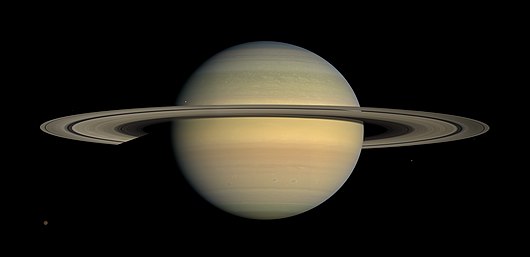
 Saturn is the sixth planet from the Sun and the second-largest in the Solar System after Jupiter. It is a gas giant with an average radius about nine times that of Earth.
The planet’s most famous feature is its prominent ring system that is composed mostly of ice particles, with a smaller amount of rocky debris and dust. At least 62 moons are known to orbit Saturn, of which 53 are officially named. This does not include the hundreds of moonlets in the rings.
Saturn’s interior is probably composed of a core of iron–nickel and rock, silicon and oxygen compounds. This core is surrounded by a deep layer of metallic hydrogen, an intermediate layer of liquid hydrogen and liquid helium, and finally a gaseous outer layer.
With a radius of 36,183.7 miles (58,232 kilometers), Saturn is 9 times wider than Earth.
From an average distance of 886 million miles (1.4 billion kilometers), Saturn is 9.5 astronomical units away from the Sun. One astronomical unit (abbreviated as AU), is the distance from the Sun to Earth. From this distance, it takes sunlight 80 minutes to travel from the Sun to Saturn.
It’s hard to imagine, but Saturn is the only planet in our solar system whose average density is less than water. The giant gas planet could float in a bath if such a colossal thing existed.