
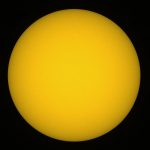
 The surface of the Sun is a very busy place. It has electrically charged gases that generate areas of powerful magnetic forces. These areas are called magnetic fields. The Sun’s gases are constantly moving, which tangles, stretches and twists the magnetic fields. This motion creates a lot of activity on the Sun’s surface, called solar activity.
Sunspots are areas that appear dark on the surface of the Sun. They appear dark because they are cooler than other parts of the Sun’s surface. The temperature of a sunspot is still very hot though—around 6,500 degrees Fahrenheit!
Why are sunspots relatively cool? It’s because they form at areas where magnetic fields are particularly strong. These magnetic fields are so strong that they keep some of the heat within the Sun from reaching the surface.
The magnetic field lines near sunspots often tangle, cross, and reorganize. This can cause a sudden explosion of energy called a solar flare. Solar flares release a lot of radiation into space. If a solar flare is very intense, the radiation it releases can interfere with our radio communications here on Earth. With a radius of 432,168.6 miles (695,508 kilometers), our Sun is not an especially large star—many are several times bigger—but it is still far more massive than our home planet: 332,946 Earths match the mass of the Sun. The Sun’s volume would need 1.3 million Earths to fill it.
The Sun is 93 million miles (150 million kilometers) from Earth. Its nearest stellar neighbor is the Alpha Centauri triple star system: Proxima Centauri is 4.24 light years away, and Alpha Centauri A and B—two stars orbiting each other—are 4.37 light years away. A light year is the distance light travels in one year, which is equal to 5,878,499,810,000 miles or 9,460,528,400,000 kilometers.
The Sun rotates as it orbits the center of the Milky Way. Its spin has an axial tilt of 7.25 degrees with respect to the plane of the planets’ orbits. Since the Sun is not a solid body, different parts of the Sun rotate at different rates. At the equator, the Sun spins around once about every 25 days, but at its poles the Sun rotates once on its axis every 36 Earth days.