
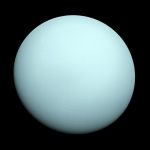
 Uranus from the Latin name Ūranus for the Greek god Οὐρανός is the seventh planet from the Sun. It has the third-largest planetary radius and fourth-largest planetary mass in the Solar System. Uranus is similar in composition to Neptune, and both have bulk chemical compositions which differ from that of the larger gas giants Jupiter and Saturn.
For this reason, scientists often classify Uranus and Neptune as “ice giants” to distinguish them from the gas giants. Uranus’ atmosphere is similar to Jupiter’s and Saturn’s in its primary composition of hydrogen and helium, but it contains more “ices” such as water, ammonia, and methane, along with traces of other hydrocarbons.
It has the coldest planetary atmosphere in our Solar System, with a minimum temperature of 49 K −224 °C / −371 °F, and has a complex layered cloud structure with water thought to make up the lowest clouds and methane the uppermost layer of clouds. The interior of Uranus is mainly composed of ices and rock.
With a radius of 15,759.2 miles (25,362 kilometers), Uranus is 4 times wider than Earth.
From an average distance of 1.8 billion miles (2.9 billion kilometers), Uranus is 19.8 astronomical units away from the Sun. One astronomical unit (abbreviated as AU), is the distance from the Sun to Earth. From this distance, it takes sunlight 2 hours and 40 minutes to travel from the Sun to Uranus.
William Herschel tried unsuccessfully to name his discovery Georgium Sidus after King George III. Instead the planet was named for Uranus, the Greek god of the sky, as suggested by Johann Bode.